


About this case study
The following article is a chapter from Sharing the Sun: Empowering small-scale renewable generation in Aotearoa (2025), published by the New Zealand Centre for Sustainable Cities, University of Otago, Wellington, sustainablecities.org.nz.
It was co-written by Josh Yeats, Biddy Livesey and David Welch who are all founding members and residents of the Cohaus development in Grey Lynn. Josh leads community energy at Revolve.
Revolve were end-to-end consultants for the community energy system scope. The Cohaus Body Corporate now uses Revolve’s Shoal platform for metering, control and billing.
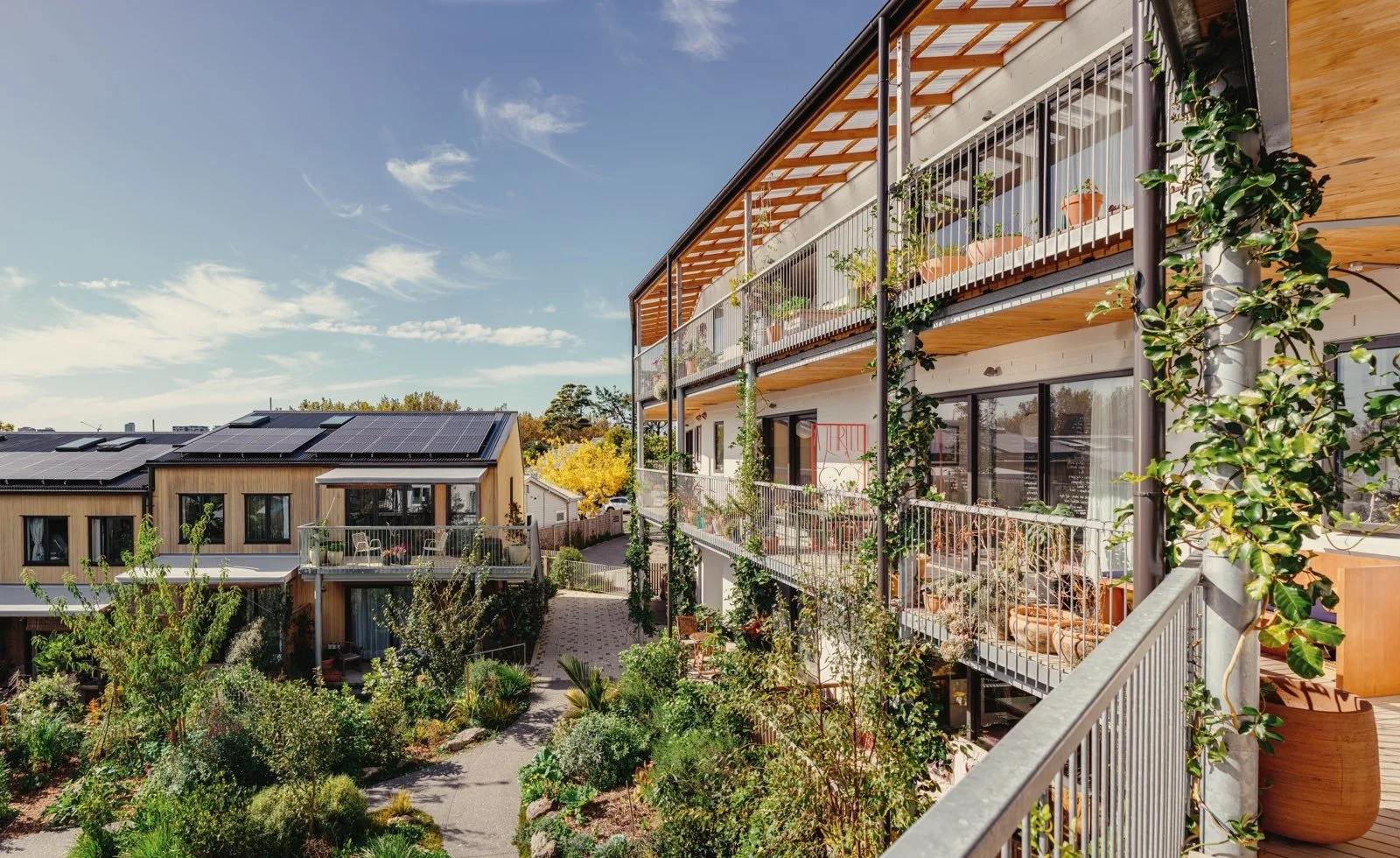
Completed in 2021, Cohaus is a cohousing development in Grey Lynn, Tāmaki Makaurau, Auckland, designed, developed and financed by residents. The medium-density development comprises 20 dwellings, ranging from a studio apartment to a five-bedroom townhouse, and includes the original villa on the site. The development uses low-carbon materials where possible, complements smaller individual dwellings with generous communal spaces, and is designed to encourage residents and visitors to walk or cycle. The development is centred around a large, north-facing garden including productive beds and native planting. Communal spaces include a garden house, a laundry, a bike stable with capacity for 60 bicycles, storage for the apartments and a guest room. The community collectively owns six electric and hybrid cars. Cohaus is currently home to 53 people.
Following completion, Cohaus adopted a vision for living as a community:
Cohaus is a place for people to make a home, connect to community, share spaces and resources, and create a better environment for everyday life.
Our gardens, infrastructure, and buildings promote wellbeing, protect our community from shocks (water shortages, climate change, food shortages) and contribute to the regeneration of the local ecosystem.
Our spaces, skills, time, knowledge, tools, food and other resources are shared within the community, and with our family, friends and neighbours.
We have a low environmental impact and our community is affordable for a range of people.
Cohaus community energy system
There are three key components of the community energy system:
a private electricity network,
a 38kWp rooftop solar photovoltaic (PV) system; and
a centralised high-efficiency heat-pump hot-water service.
The system also includes a load-control mechanism to ensure that electricity use stays within the capacity available from the lines company. The system is managed through software developed by engineering consultants Revolve Energy to support consumer-owned networks, and to enable communities to manage their energy system.
Private electricity network
Like many multi-unit developments in Aotearoa New Zealand, Cohaus operates a private electricity network, with a single connection to the grid. This network supplies electricity to all 20 units, as well as providing electricity for shared utilities including the laundry, lighting in common areas, hot water and electric vehicle charging. There is one gate meter for the whole development, at the point where the network connects to the grid. Cohaus has one account with the local lines company Vector, and one account with an energy retailer. Having a single connection required less initial capital cost, and has a lower ongoing operating cost, as it attracts only a single standing charge from the energy retailer. Within the development, there is a check meter for each unit, which enables the body corporate to measure and bill each unit for their actual usage.
Rooftop solar
Cohaus generates electricity through photovoltaic panels. The development is on a north-facing site on the Grey Lynn ridge, and the buildings are grouped around an internal garden. One hundred and twenty-four 310-watt solar panels are mounted on the internal, sunny side of the gabled roof. These panels can generate up to 38kW at their peak, and energy is fed into the private electricity network. The $90,000 cost of purchasing and installing the photovoltaic panels was financed by a loan, recently repaid, from one of the households. (At the time of writing, 1 NZD ≈ €0.49 / £0.43 / US$0.56.)
Central hot-water heating plant
Cohaus has a single connection to Auckland's Watercare network, and a central hot-water heating plant which delivers hot water to the units and laundry via a ring main system. The plant, by Stiebel Eltron and Collins Plumbing, comprises two tanks with a combined capacity of 2,860 litres and a highly efficient heat-pump water heater, located on the ground floor of the three-storey apartment building. A ring main system is required when there is a long distance between the hot water plant and the outlets, and includes a large supply pipe and a small return pipe to allow water to flow back to the water heater. A pump keeps the hot water moving slowly around the system, so that hot water is always available at the connection point to each unit, delivering quick and nearly endless hot water. The central hot water heating plant cost about $100,000, roughly double the cost of installing conventional hot water heaters in each individual unit. However, the incremental capital cost of the heat-pump system has been recovered through energy savings in less than 3 years ($15,000 in operational savings per year, increasing over time). Furthermore, avoiding installing individual hot water cylinders saved over 1m² in floor area in each unit, collectively valued at over $200,000 for the 20 units.
Load-control mechanism
The community electricity system also includes load-control. During the design phase, Cohaus was advised by the electrical building services engineer that, based on conventional modelling, the development would require a connection size of 250A. The lines company, Vector, did not have that capacity available and told Cohaus that an upgrade to the network (i.e. installing a distribution transformer on-site) would be required. The transformer was estimated to cost approximately $152,000+GST, which would be paid by Cohaus. Lengthy conversations with Vector eventually revealed that the transformer would only be required if the development used more than existing local capacity, which was established to be 180A (three-phase). Cohaus consulted a second engineer, who assessed the actual appliances proposed in each apartment and the likely load required. It was calculated that the load required by the development would be well under 180A, and Cohaus could ensure the development stayed within that limit by installing a load capacity mechanism. This mechanism was much cheaper to install and, unlike the transformer, did not require space on the property. Because line charges are calculated based on capacity, having a capacity of 180A that is 30% less than 250A also saves approximately $750 per year in ongoing costs.
The load-control mechanism manages demand for electricity to ensure that use does not exceed 180A. The mechanism also enables Cohaus to reduce the operational cost of electricity by superheating the water stored in the tanks when photovoltaic generation exceeds demand and using these as thermal batteries. Superheating effectively load-shifts the timing of the hot-water heating and reduces the amount of electricity imported from the grid to heat water. If the development is nearing the maximum capacity the load-control mechanism will automatically turn off or delay three loads (in the following order): the smart fast chargers for the electric vehicles; the hot water heater; and the space heaters within each individual unit, which are plugged into a dedicated circuit.
The units are well insulated so little heating is required, and residents can choose the number and size of heaters within their unit on the understanding that they use only the dedicated outlets for heaters in each room. In reality, electricity use by Cohaus has never exceeded 103A, just over half the level where devices would need to be cut. The load-control mechanism also aims to utilise the solar energy generated on-site, by heating the hot water during the day. There is a boost scheduled at 4am to ensure there is sufficient hot water for morning activities. If Cohaus moves to time-of-use tariffs for imported electricity in the future, the load-control mechanism could be used to take advantage of lower tariffs by heating water at off-peak times.
Software to support consumer-owned networks
The community energy system is managed using the Shoal software platform developed by Revolve Energy to support consumer-owned networks. Comprehensive monitoring captures data relating to electricity and cold and hot water use. Data on the use of shared cars is also collected automatically through an online booking app, and data on the use of the laundry and items purchased from the Cohaus store are collected manually.
The software:
acquires and stores the metered electricity, hot water and cold water use of each unit;
allocates the costs of the shared cars based on distance travelled and time used;
automatically generates monthly invoices for the services, which are transmitted into accounting software Xero, which is then used to send and manage invoices.
The software provides a dashboard which presents all the data from individual units, as well as data from check meters for the hot-water plant, photovoltaics and electric-vehicle chargers. This dashboard, and several others, allows the body corporate to track and understand generation and consumption of electricity, hot water and cold water. A simplified dashboard can be shared with residents to allow them to understand the best time to use electricity and hot water. The system also tracks costs and savings in real time to allow live reporting of cost and carbon savings.
Results of the community energy system
This community energy system has resulted in affordable, sustainable, convenient utilities for Cohaus residents. Each month, households receive a single utility bill containing all charges relating to electricity, cold water, hot water, internet, laundry and shared cars. One resident operates this billing system and manages the relationship with the energy retailer. Because this requires significant monthly effort, this is a paid role.
The 12-month total indicates that 35% of the electricity used by Cohaus is generated on-site, and of the electricity generated on-site, approximately half is used by Cohaus and the other half exported to the grid. Cohaus generates a significant amount of electricity from the PVs, but also imports a significant amount — especially in the winter months — because the on-site generation doesn’t coincide with the community’s peak use times (4am for the hot water plant and 6pm for the dwellings).
Dwellings at Cohaus use a relatively low amount of energy. The government has set a goal for dwellings to use 45 kWh/m² by 2035. All units at Cohaus are already meeting this target, with 75% of units directly using less than 30 kWh/m². Energy use per square metre rises when energy for hot water and use in common spaces is included, but 90% of units remain below the target.
Households at Cohaus also pay relatively low costs for utilities. Over the last three years, the average utility cost for a household at Cohaus was $155 per month. This figure includes electricity, hot water, cold water, internet, use of washing machines and dryers in the common laundry, and billing costs. Over the past year, this average utility cost has risen to $184 per month, reflecting price increases from the electricity retailer. Low utility bills also reflect the fact that the average dwelling at Cohaus (85.3m²) is smaller than the average new-build house in Aotearoa New Zealand (126m²) and the average multi-unit dwelling (100 m²).
Charges for utilities are set by the community at a rate calculated to include the cost of usage plus the cost to replace the asset at the end of its lifetime (depreciation). Electricity generated on-site is charged to residents at the same price as electricity imported from the grid. This revenue is used to pay back the ten-year loan for the purchase and installation of the photovoltaic panels. Over three years, we have repaid $40,000 of the $90,000 loan. Once the loan is repaid, we can choose to reduce costs to residents, or to invest in improving our community energy system. The photovoltaic panels have an expected life of 25 years or more.
Other benefits from the community energy system
Establishing the billing infrastructure for a community energy system has also allowed Cohaus residents to access other utilities at a cheaper cost. The single broadband internet connection is cheaper and simpler for residents than multiple individual connections, and allows community-wide Wi-Fi coverage. The billing infrastructure is also used to monitor and charge for the use of shared cars, laundry and bulk-bought items from the Cohaus shop.
The shared car scheme is critical to the design of Cohaus, which minimised the area allocated for car parking and maximised the area available for bicycle storage. The six cars are collectively owned by the body corporate, and include two electric and four hybrid vehicles. Residents and guests can book a car using an online booking platform and are charged for mileage and usage time.
Conclusion
The community energy system at Cohaus has succeeded in providing affordable electricity for residents, and in increasing the sustainability of Cohaus by allowing residents to use a significant amount of electricity generated on-site. The strong sense of community at Cohaus, plus a vision centering sustainability and affordability coupled with collective purchasing power, meant that residents could easily see the value in taking on a loan to purchase the PV panels and committing to a long timeframe to pay it off.
Lessons learnt from the Cohaus experience include the significant role of resident participation in setting up, maintaining and operating the community energy system. The system provides the infrastructure for a range of other collective activities in the Cohaus economy. Future improvements include charging different rates for electricity generated on-site versus imported from the grid, setting chargers to charge electric vehicles at night, further electrifying the vehicle fleet, and adding batteries to reduce the amount of energy exported.